,

BlackByte 2.0 Ransomware

TLP

TLP CLEAR

Authors

Jordi M. Lobo

Summary

BlackByte 2.0 Ransomware Abuses Vulnerable Windows Driver to Disable Security Solutions, believed to be an offshoot of the now-discontinued Conti group, is part of the big game cybercrime crews, which zeroes in on large, high-profile targets as part of its ransomware-as-a-service (RaaS) scheme.

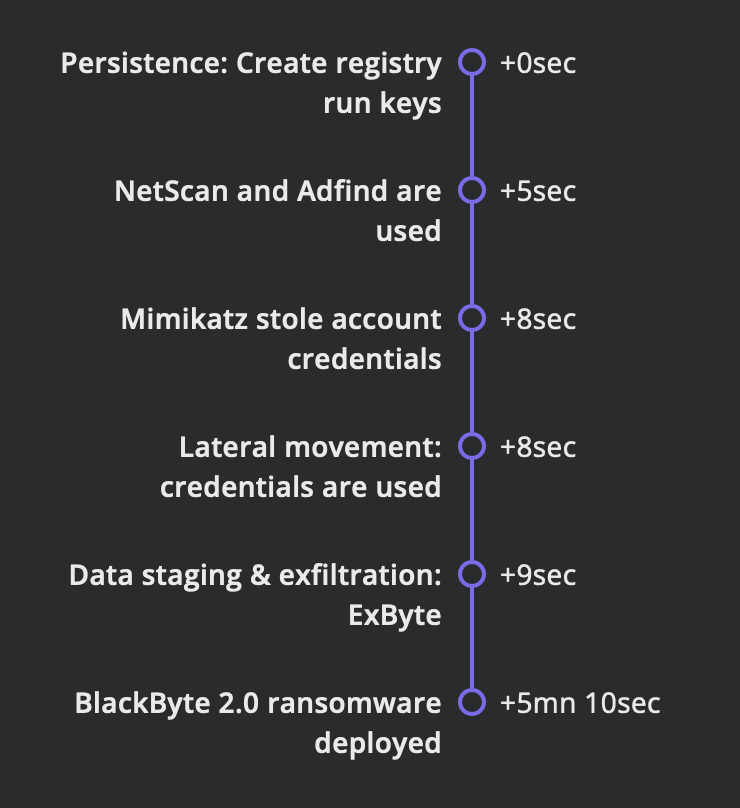
The forensic analysis revealed that the threat actor gained initial access through exploiting ProxyShell vulnerabilities on unpatched Microsoft Exchange Servers. They achieved system-level privileges and created web shells for remote control. A backdoor was installed to collect system information and communicate with a command-and-control (C2) channel. Cobalt Strike Beacon was utilized for persistence, and AnyDesk was used for remote access. Reconnaissance involved network enumeration and Active Directory reconnaissance. Credential theft using Mimikatz was observed. Lateral movement occurred through RDP and PowerShell remoting. Data staging and exfiltration involved a custom tool called ExByte. Data encryption and destruction were carried out using BlackByte ransomware. Recommendations include patch management, endpoint detection and response, and implementing security measures to prevent unauthorized system changes.

DATA

TIMELINE
CATEGORY

Ransomware

references

MITRE ATT&CK

[contact-form-7 id=”f245613″ title=”Newsletter”]

T1003.001 – LSASS Memory T1005 – Data from Local Syste T1012 – Query Registry T1016 – System Network Configuration Discovery T1018 – Remote System Discovery T1021.001 – Remote Desktop Protocol T1021.002 – SMB/Windows Admin Shares T1021.004 – SSH T1027 – Obfuscated Files or Information T1033 – System Owner/User Discovery T1036.005 – Masquerading: Match Legitimate Name or Location T1041 – Exfiltration Over C2 Channel T1047 – Windows Management Instrumentation T1053.005 – Scheduled Task/Job: Scheduled Task T1055 – Process Injection T1057 – Process Discovery T1059 – Command Line Interface T1059.001 – Command and Scripting Interpreter: PowerShell T1059.003 – Windows Command Shell T1069 – Permission Groups Discovery T1069.001 – Local Groups T1069.002 – Domain Groups T1070.004 – File Deletion T1071 – Application Layer Protocol T1071.001 – Web Protocols T1078 – Valid Accounts T1082 – System Information Discovery T1083 – File and Directory Discovery T1087.002 – Domain Account T1105 – Ingress Tool Transfer T1110.001 – Brute Force: Password Guessing T1112 – Modify Registry T1140 – Deobfuscate/Decode Files or Information T1190 – Exploit Public-Facing Application T1204.002 – User Execution: Malicious File T1210 – Exploitation of Remote Services T1218.011 – System Binary Proxy Execution: Rundll32 T1219 – Remote Access Software T1482 – Domain Trust Discovery T1486 – Data Encrypted for Impact T1490 – Inhibit System Recovery T1518.001 – Security Software Discovery T1543.003 – Create or Modify System Process: Windows Service T1566.001 – Phishing: Spearphishing Attachment T1574.002 – DLL Side-Loading