,

oneday SSH bruteforce

TLP

TLP CLEAR

Author

David Deflache

Summary

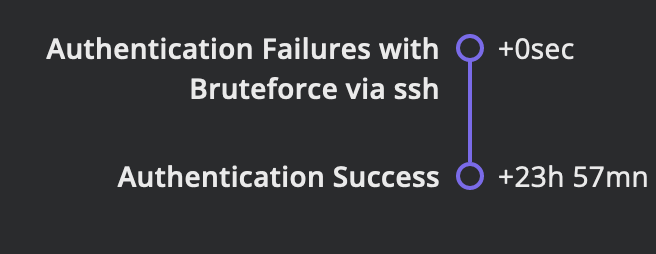
In this attack scenario, an individual with the IP address 192.168.0.42 and a valid username is engaging in an authentication brute force attack through SSH. Their target is a system with the IP address 192.168.0.111, using the default SSH port 22. The attacker executes a loop of 350 iterations, simulating numerous login attempts. Each attempt is marked as a failed login, triggering the action “User.LoginFailed.” A random delay between 3 to 5 minutes is introduced after each failed attempt. After the loop, there is a final pause of 3 minutes. The attacker then achieves a successful login, triggering the action “User.LoginSuccess.” This scenario illustrates an unauthorized access attempt through repeated SSH login trials. Can you detect it ?

DATA

TIMELINE
CATEGORY

Malware

references

MITRE ATT&CK

[contact-form-7 id=”f245613″ title=”Newsletter”]

T1003.001 – LSASS Memory T1005 – Data from Local Syste T1012 – Query Registry T1016 – System Network Configuration Discovery T1018 – Remote System Discovery T1021.001 – Remote Desktop Protocol T1021.002 – SMB/Windows Admin Shares T1021.004 – SSH T1027 – Obfuscated Files or Information T1033 – System Owner/User Discovery T1036.005 – Masquerading: Match Legitimate Name or Location T1041 – Exfiltration Over C2 Channel T1047 – Windows Management Instrumentation T1053.005 – Scheduled Task/Job: Scheduled Task T1055 – Process Injection T1057 – Process Discovery T1059 – Command Line Interface T1059.001 – Command and Scripting Interpreter: PowerShell T1059.003 – Windows Command Shell T1069 – Permission Groups Discovery T1069.001 – Local Groups T1069.002 – Domain Groups T1070.004 – File Deletion T1071 – Application Layer Protocol T1071.001 – Web Protocols T1078 – Valid Accounts T1082 – System Information Discovery T1083 – File and Directory Discovery T1087.002 – Domain Account T1105 – Ingress Tool Transfer T1110.001 – Brute Force: Password Guessing T1112 – Modify Registry T1140 – Deobfuscate/Decode Files or Information T1190 – Exploit Public-Facing Application T1204.002 – User Execution: Malicious File T1210 – Exploitation of Remote Services T1218.011 – System Binary Proxy Execution: Rundll32 T1219 – Remote Access Software T1482 – Domain Trust Discovery T1486 – Data Encrypted for Impact T1490 – Inhibit System Recovery T1518.001 – Security Software Discovery T1543.003 – Create or Modify System Process: Windows Service T1566.001 – Phishing: Spearphishing Attachment T1574.002 – DLL Side-Loading